Industrial equipment is the backbone of any production-driven business. From manufacturing units and warehouses to food processing plants and commercial kitchens, machinery directly impacts efficiency, safety, compliance, and profitability. Unlike routine purchases, industrial equipment procurement involves high capital investment, long usage cycles, and operational dependencies that can last for decades.
Yet, despite its importance, many businesses approach industrial equipment procurement in an unstructured and reactive manner. Decisions are often rushed, driven by urgency, price pressure, or incomplete information. The result? Frequent breakdowns, operational downtime, regulatory non-compliance, cost overruns, and frustrated teams.
This comprehensive guide by Metoraa explores the most common mistakes businesses make while buying industrial equipment, why they happen, and how organizations can avoid them through smarter, more disciplined procurement practices.
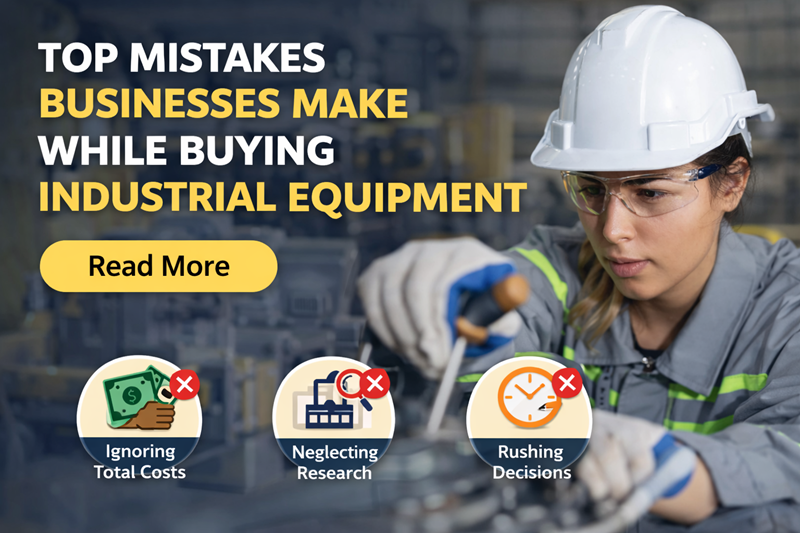
1. Treating Industrial Equipment as a One-Time Purchase
One of the most fundamental mistakes businesses make is viewing industrial equipment as a one-time expense instead of a long-term operational asset.
Many buyers focus on:
- Immediate availability
- Lowest quoted price
- Short-term budget constraints
They fail to consider how the equipment will perform:
- Over 5, 10, or 15 years
- Under continuous or heavy-duty usage
- During peak production cycles
- When maintenance or repairs are required
Why this is dangerous:
Industrial equipment is deeply integrated into workflows. Poor choices affect not just machines, but manpower, output quality, safety, and customer commitments.
Best Practice:
Always evaluate equipment as a long-term operational partner, not just a capital expense.
2. Poor Requirement Definition and Incomplete Specifications
Many procurement teams jump directly to vendor discussions without clearly defining what they actually need.
Common gaps include:
- Undefined production capacity
- Ignoring shift patterns and duty cycles
- Overlooking material characteristics
- Not accounting for space, utilities, or layout
- No clarity on automation or manual operation
Result:
- Equipment that underperforms
- Excessive wear and tear
- Workflow inefficiencies
- Costly retrofitting or replacement
Best Practice:
Create a detailed requirement specification covering technical, operational, and environmental parameters. Metoraa helps businesses translate operational needs into accurate equipment specifications.
3. Choosing the Cheapest Option Without Evaluating Risk
Price-based buying is one of the most common and costly procurement mistakes.
Low-cost equipment often comes with:
- Inferior build quality
- Higher power consumption
- Limited-service support
- Shorter lifespan
- Non-standard spare parts
Hidden costs include:
- Frequent repairs
- Production stoppages
- Higher energy bills
- Operator frustration
- Missed delivery commitments
Best Practice:
Always evaluate Total Cost of Ownership (TCO) instead of upfront price alone. TCO includes energy use, maintenance, downtime, and replacement costs.
4. Ignoring Compliance, Safety, and Legal Obligations
Industrial equipment must comply with multiple laws and standards in India, such as:
- Factory Act regulations
- BIS / IS standards
- Electrical safety norms
- Fire and environmental regulations
- Industry-specific certifications
Many businesses assume compliance is “optional” or the vendor’s responsibility.
Reality:
Non-compliance can lead to:
- Legal notices and penalties
- Factory shutdowns
- Insurance claim rejection
- Worker injuries and liabilities
Best Practice:
Compliance must be verified before purchase, not after installation. Metoraa works with verified suppliers who understand regulatory requirements and provide proper documentation.
5. Selecting Vendors Without Due Diligence
Choosing a vendor solely based on price or fast delivery is a recipe for long-term trouble.
Common vendor mistakes include:
- No background verification
- No service infrastructure
- Poor warranty coverage
- Unclear spare part policies
- Inconsistent communication
Long-term consequences:
- Extended downtime during breakdowns
- Dependency on third-party technicians
- Escalating maintenance costs
- Operational uncertainty
Best Practice:
Evaluate vendors based on reliability, service capability, warranty, and spare part availability - not just pricing. Metoraa simplifies vendor evaluation by connecting businesses with vetted suppliers.
6. Overlooking Installation, Training, and Commissioning
Many businesses treat equipment installation as an afterthought.
Ignoring:
- Proper alignment and calibration
- Operator training
- Safety orientation
- Preventive maintenance planning
leads to:
- Improper usage
- Reduced output
- Increased accidents
- Shortened equipment life
Best Practice:
Ensure installation, commissioning, and training are included in the procurement scope. Metoraa emphasizes end-to-end support beyond just delivery.
7. Not Considering Energy Efficiency and Operating Costs
Energy consumption is a major ongoing cost for industrial equipment.
Common oversights:
- Ignoring power ratings
- Not evaluating energy efficiency
- Overloading existing electrical systems
- No monitoring or optimization plan
Impact:
- High monthly energy bills
- Power quality issues
- Equipment overheating
- Reduced sustainability compliance
Best Practice:
Select energy-efficient equipment aligned with your facility’s power infrastructure.
8. Failing to Plan for Scalability and Expansion
Businesses often buy equipment that meets today’s needs but fails tomorrow’s growth.
This results in:
- Early upgrades
- Production bottlenecks
- Integration challenges
- Capital duplication
Best Practice:
Choose modular, scalable equipment that can grow with your business over the next 3–5 years.
9. Ignoring Maintenance Strategy and Spare Availability
Maintenance is often treated as a future problem.
Common mistakes:
- No preventive maintenance plan
- Non-standard spare parts
- Single-vendor dependency
- No local service support
Consequences:
- Extended breakdown periods
- Emergency repair costs
- Production losses
Best Practice:
Ensure spare parts are easily available and maintenance schedules are clearly defined at the time of purchase.
10. Not Comparing Multiple Options Before Finalizing
Relying on a single vendor quote reduces negotiation power and visibility.
Without comparison, businesses may:
- Overpay
- Miss better technology
- Accept weak warranty terms
- Choose outdated models
Best Practice:
Always compare multiple suppliers, models, and pricing structures. Metoraa enables transparent side-by-side comparison for informed decision-making.
Why Industrial Procurement Requires a Strategic Approach
Industrial equipment procurement is no longer just a purchasing function it is a strategic business decision.
Smart procurement delivers:
- Higher uptime
- Lower operational risk
- Better compliance
- Improved ROI
- Long-term scalability
Poor procurement decisions, on the other hand, compound problems over time.
Why Businesses Across India Choose Metoraa
- Verified industrial suppliers
- Transparent pricing and comparisons
- Compliance-focused procurement
- Industry-specific expertise
- End-to-end procurement support
Metoraa bridges the gap between industrial buyers and reliable suppliers helping businesses avoid costly mistakes and procure with confidence.
Conclusion: Buy Industrial Equipment with Strategy, Not Urgency
Industrial equipment should enable growth not create recurring problems.
By avoiding common mistakes such as poor requirement definition, price-only decision-making, ignoring compliance, and choosing unreliable vendors, businesses can transform procurement into a competitive advantage.
A structured procurement approach ensures:
- Reduced downtime
- Improved safety
- Long-term cost savings
- Sustainable operations
With the right planning and platforms like Metoraa, industrial equipment procurement becomes a strategic investment not a costly gamble.
Frequently Asked Questions (FAQs)
Q1. What is the biggest mistake businesses make when buying industrial equipment?
Focusing only on upfront cost while ignoring long-term operating expenses, downtime risk, and maintenance requirements.
Q2. How important is compliance when buying industrial equipment in India?
Compliance is mandatory. Non-compliant equipment can result in legal penalties, shutdowns, and insurance issues.
Q3. How can businesses ensure they are not overpaying for equipment?
By comparing multiple suppliers, evaluating total cost of ownership, and using transparent procurement platforms like Metoraa.
Q4. Should installation and training be part of procurement?
Yes. Proper installation and operator training are critical for safety, performance, and equipment lifespan.