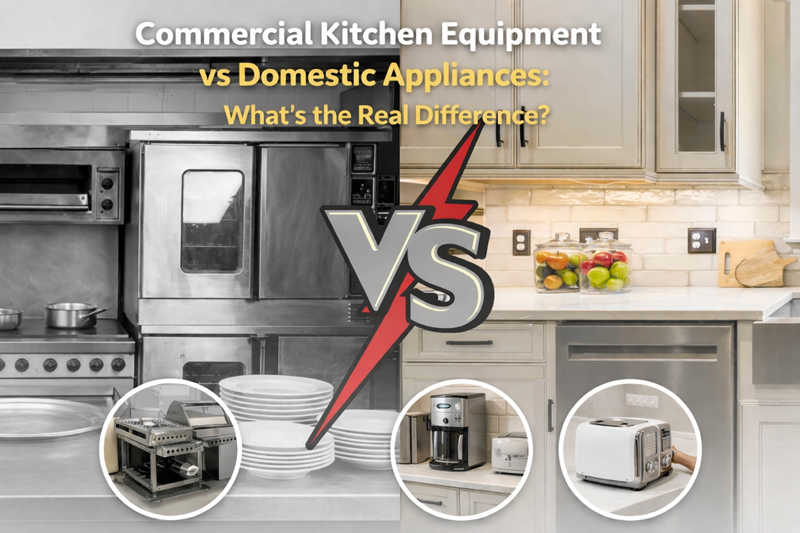
Many food entrepreneurs - especially those starting restaurants, cloud kitchens, bakeries, or cafes - make a costly mistake: using domestic appliances in commercial kitchens. At first glance, home microwaves, refrigerators, ovens, or mixers may appear cheaper and convenient. However, this decision often backfires, leading to frequent breakdowns, safety risks, hygiene issues, and regulatory problems.
Understanding the real difference between commercial kitchen equipment and domestic appliances is crucial for ensuring smooth operations, food safety, efficiency, and long-term profitability. This guide dives deep into why commercial-grade equipment is a necessity for high-volume food operations.
1. Purpose and Design Differences
The primary difference lies in design and intended usage:
- Domestic appliances are designed for occasional use, typically a few hours a day.
- Commercial kitchen equipment is engineered for heavy-duty, continuous operation - often 12-18 hours a day.
Commercial equipment is specifically designed to withstand:
- High heat and moisture
- Continuous heavy load
- Frequent cleaning cycles
- Fast-paced kitchen operations
Example: A domestic oven may handle a few meals per day, while a commercial convection oven can bake dozens of pizzas simultaneously without overheating.
2. Capacity and Volume Handling
High-capacity kitchens need machines that can match output demand.
- Domestic appliances: Limited capacity, slower cooking or cooling, prone to overheating during high-volume operations.
- Commercial equipment: High-capacity cooking, refrigeration, and storage; designed to handle multiple batches simultaneously; consistent performance during peak hours.
Example: Frequent door openings in a domestic refrigerator can compromise temperature, spoiling food. Commercial refrigerators maintain consistent temperatures despite heavy usage.
3. Durability and Long-Term Performance
One of the biggest hidden costs of using domestic appliances in a commercial kitchen is their short lifespan:
- Domestic appliances wear out quickly under continuous use.
- Motors, compressors, and heating elements fail prematurely.
Commercial kitchen equipment uses:
- Industrial-grade motors
- Heavy-duty stainless-steel bodies
- Corrosion-resistant materials
Investment Tip: A high-quality commercial oven may last 8-12 years, compared to 2-3 years for a domestic one under similar use.
4. Safety and Regulatory Compliance
Food businesses must follow strict safety and hygiene regulations:
- Commercial equipment meets FSSAI, electrical safety, and fire safety standards.
- Domestic appliances are not certified for commercial use, creating higher risks of electrical faults, fires, and regulatory penalties.
Pro Tip: Using non-compliant appliances may jeopardize food licenses and invite fines.
5. Hygiene and Cleaning Standards
Maintaining high hygiene standards is critical in a commercial kitchen.
- Commercial equipment: Smooth, food-grade stainless steel surfaces; easy-to-clean designs; resistant to bacteria.
- Domestic appliances: Plastic coatings, harder to clean, and less resistant to high-temperature cleaning.
Example: Dishwashers in restaurants are designed for frequent cleaning cycles and sanitization, unlike domestic models.
6. Energy Efficiency Under Heavy Usage
Domestic appliances may appear cost-effective, but under continuous usage, their efficiency drops, leading to higher energy bills and potential failures.
- Commercial equipment: Optimized for high-volume operations, maintains efficiency under heavy loads.
- Domestic appliances: Can overheat, consume more electricity, and require frequent repairs.
Tip: Look for energy-star or certified commercial appliances to save on operational costs.
7. Maintenance and Support
Commercial equipment manufacturers offer:
- Warranties
- Spare parts availability
- Technical support and preventive maintenance
Domestic appliances often lack commercial-grade service, making downtime costly in busy kitchens.
8. Total Cost of Ownership
While domestic appliances may be cheaper upfront, total cost of ownership tells a different story:
| Factor | Domestic Appliances | Commercial Kitchen Equipment |
| Initial Cost | Low | Higher |
| Lifespan | 2-3 years | 8-12 years |
| Maintenance | Frequent & costly | Minimal & planned |
| Energy Efficiency | Low under heavy load | High |
| Compliance | Not compliant | Fully compliant |
| Long-term Cost | High | Cost-effective |
Investing in commercial-grade equipment ensures long-term savings, reduced downtime, and better operational efficiency.
9. Supplier Reliability and Marketplace Options
Buying from trusted suppliers or platforms is crucial. Reputable marketplaces like Metoraa provide:
- Verified, high-quality commercial kitchen equipment
- Transparent pricing
- Expert consultation
- After-sales support
Tip: Avoid local unverified sellers; long-term reliability is more valuable than short-term savings.
10. Future-Proofing Your Kitchen
When buying equipment, consider scalability:
- Can the machine handle increased production?
- Is modular expansion possible?
- Can it accommodate a changing menu?
Planning for growth prevents expensive replacements as your business expands.
11. Practical Examples
| Equipment | Domestic vs Commercial | Impact |
| Refrigerator | Domestic: 300L | Commercial: 1200L |
| Mixer | Domestic: 5L | Commercial: 20-50L |
| Oven | Domestic: Single rack | Commercial: Multi-rack convection |
| Fryer | Domestic: Single basket | Commercial: Multiple baskets |
Frequently Asked Questions (FAQs)
Q1. Can domestic appliances be used in commercial kitchens?
Domestic appliances are not recommended in commercial kitchens as they are not designed for continuous, high-volume use and lack regulatory compliance. Frequent breakdowns and safety risks make them unsuitable.
Q2. Why is commercial kitchen equipment more expensive?
Commercial equipment uses industrial-grade materials, higher capacity components, safety features, and has a longer lifespan. The cost reflects durability, compliance, and efficiency.
Q3. Are commercial kitchen appliances mandatory for licensing?
Yes, most food safety authorities require certified, commercial-grade equipment to meet hygiene and safety standards. Non-compliance can lead to penalties or license revocation.
Q4. How does commercial equipment save money in the long run?
Despite a higher upfront cost, commercial equipment saves money through energy efficiency, durability, reduced maintenance, and fewer replacements, making it cost-effective over time.
Conclusion
Using domestic appliances in a commercial kitchen may seem cost-effective initially, but it often results in operational inefficiencies, safety hazards, regulatory issues, and higher long-term costs. Commercial kitchen equipment is purpose-built for heavy use, hygiene compliance, energy efficiency, and business growth. For serious food businesses restaurants, cafés, hotels, cloud kitchens, and bakeries investing in commercial-grade appliances is essential for success.